MRI Technologist Program

MRI Technologist Program
Overview
Our MRI Technologist Program is a 9-month certificate program in magnetic resonance imaging (MRI). Students will learn to produce computerized magnetic images of anatomy as an aid in the diagnosis of disease and injury. The program runs once each year, beginning in July.
Graduates of this program are eligible to take the advanced certification exam provided by the American Registry of Radiologic Technologists (ARRT) (MR).
University of Utah Health oversees 13 superconducting magnets, ranging from 1.5 to 3.0 Tesla. The program offers a combination of clinical and didactic educational experiences that provides the student with the necessary knowledge and skills to become an entry-level MRI technologist. Students will have opportunity to work with MRI technologists at the University Hospital, Huntsman Cancer Hospital, the Clinical Neurosciences Center, South Jordan Health Center, Farmington Health Center and Sugar House Health Center.
What is magnetic resonance imaging (MRI)?
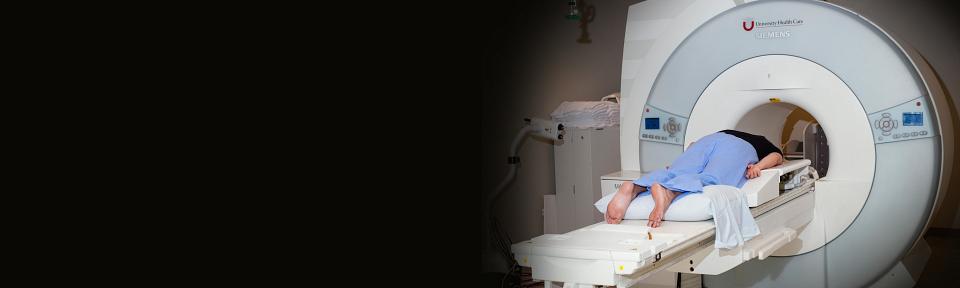
Magnetic resonance imaging (MRI) uses a strong magnetic field and radio waves in conjunction with a computer to generate cross-sectional, three-dimensional images of patient anatomy. It can be used to image many parts of the body, such as the brain, optic nerves, brainstem, spine, heart, abdomen, pelvis, musculoskeletal (muscles and joints) and blood vessels.
In MRI there is no ionizing radiation utilized, however, care must be taken as to who is placed in the magnetic field because the field is so strong that it may pull any metal that is inside or outside of the patient’s body. The MRI program assures that students use equipment and accessories, employ techniques, and perform procedures in accordance with accepted safe practices to minimize risk to patients, selves and others.
What are the responsibilities of an MRI technologist?
An MRI technologist independently performs procedures with efficiency and skill. The technologist must have a thorough knowledge of anatomy and the ability to make judgments about the MRI pulse sequencing, gradient magnetic fields and anatomic slice orientation. Knowledge about magnetic fields, electromagnets, atomic structure and computers is essential. Patient care responsibilities require knowledge of sterile technique, administration of contrast media, ability to handle emergency procedures and routine performance of venipuncture. The MR technologist needs to effectively work with claustrophobic patients and be constantly aware of magnetic safety of patients, self and co-workers. On-the-job training of MR technologists does not effectively meet the educational needs of today's MR technologists. As a technologist learning the art of MRI, you deserve a well-structured educational process.
How do I become a MRI Technologist?
As of January 2006, MRI is recognized as a primary certification by The American Registry of Radiologic Technologists (ARRT), however the majority of MR technologists are radiographers who have added MR as a post-primary certification. Successful completion of the MR examination certifies a technologist as competent and knowledgeable in MR imaging. Certification in MRI is valued in the medical community and perceived as distinction over non-certified technologists. Completion of the MRI program at the University of Utah qualifies and prepares the student for the ARRT examination. The MR examination consists of 200 multiple choice questions that pertain to the field of magnetic resonance imaging.
University of Utah Health's MRI program has been very successful since it began in 2004. Favorable graduate feedback praises the University for program comprehensiveness, quality of teaching and state-of-the-art equipment at a world-class institution. The program can be completed within a reasonable length of time and tuition costs are competitive. Students will learn from the finest of instructors in an organized classroom setting and practice the most current procedures with experienced and certified MR technologists. Many of the students are working in MR by the time they complete the program.
PROGRAM INFORMATION
PREREQUISITES
POST PRIMARY
To be eligible for the MRI Technologist Program post-primary path, you must complete the following prerequisites:
- Current certification from ARRT in one of the following categories, or will have completed the ARRT certification exam by the start of the program:
- Radiography (ARRT)
- Radiation Therapy (ARRT)
- Nuclear Medicine Technology (ARRT or NMTCB)
- Observation experience*:
- A requirement for radiography applicants will be 12 hours (minimum) of observational experience in a general radiology department. University of Utah Hospital will provide 4 hours of this time (see below for observation application) but the candidate will need to identify an additional 8-hours of time from additional hospital or clinic radiology departments.
- To request observation with U Health, please visit: Observation Application.
- Out of state candidates please inquire with the program administrator for additional options in your home location.
*The observation experience is meant to provide practical experience in a clinical radiology department, so that the candidate may learn what some general expectations and responsibilities of an MRI technologist will be. Gaining varied experiences will help to increase this knowledge, as each clinical site will operate differently and perform different exams.
PRIMARY PATHWAY
The MRI Technologist Program primary pathway requirements are as follows:
- Minimum Associate level degree (any major)
- Minimum cumulative GPA: 2.8
*(2026 cohort GPA average = 3.6; GPA range = 3.1- 4.0)
- Courses: Human Anatomy w/Lab and Physics courses may not be older than seven years. Most college or university courses accepted. A minimum of C grade or higher is required in all prerequisite courses listed:
Note: Beginning with 2028 applications all prerequisite courses must be complete prior to application. Please see FAQ section for more information.
- Human Anatomy + Lab (in-person cadaver lab is strongly recommended)
- Physics (Note: PHYS 1110 – Physics of Human Body does not satisfy this requirement)
- Medical Terminology
- Math (minimum Intermediate Algebra, or higher)
Course Articulation: If you are interested to find out which courses and course numbers satisfy the prerequisites for your program, please review our updated course articulation document which contains this information from most of the universities and colleges in Utah. Please note that this list contains our preferred courses for the prerequisites, but there may be others that would be acceptable. If you do not see your course listed here and you are curious if would satisfy the requirement, please contact the program administrator, Otto Casal by email.
- Observation experience:
- A requirement for radiography applicants will be 12 hours (minimum) of observational experience in a general radiology department. University of Utah Hospital will provide 4 hours of this time (see below for observation application) but the candidate will need to identify an additional 8-hours of time from additional hospital or clinic radiology departments.
- To request observation with U Health, please visit: Observation Application.
- Out of state candidates please inquire with the program administrator for additional options in your home location.
*The observation experience is meant to provide practical experience in a clinical radiology department, so that the candidate may learn what some general expectations and responsibilities of a radiology tech will be. Gaining varied experiences will help to increase this knowledge, as each clinical site will operate differently and perform different exams.
- Patient Care experience (80 hours minimum)
- Patient care experience can be from previous healthcare work.
- This can be from either volunteer work or current/previous work in a healthcare/clinical setting.
- It should be direct patient care, where you were involved working with patients directly and other healthcare staff. Examples include, but are not limited to: CNA, MA, Phlebotomy, Public/Social/Community health settings.
- If looking for volunteer work, you should contact hospitals, clinics and/or free clinics in your area to find opportunities that may work.
TUITION
- Tuition for the 2027 program is $5,000.00.
- Payment Plan Options:
- Payment in full by first week of the program
- 2 payments: 1st payment due first week of program, final payment due 3 months following start of program.
- 3 payments: 1st payment due first week of program with 2nd & 3rd payments due 3rd and 5th months of program.
Note: Beginning with the 2028 program the tuition will increase to $6,000.
Our MRI Program is offered as a certificate-only program. We cannot accept or process any federal financial aid or federal scholarships. However, there may be scholarship opportunities available through various radiologic technology societies. We encourage you to contact these organizations directly for more information and available offerings.
Additional Fees
The following are approximate costs and are subject to change:
- Scrubs: $100.00+
- Parking pass: $270.00
- Textbooks: Approx. $300.00 (we have some options to reduce this cost, students in the program will be notified of these options before the program begins)
What is the cohort size for the program?
- The program admits approximately 16 students per session. Students are selected from an applicant pool and can reapply for the following session if they are not admitted. See our How to Apply page for more information.
- How competitive is the program?
- The program has become quite competitive in the past few years. We currently receive between 35-40 applications per program session.
What are some areas that are looked at to determine selection?
- The program will review each candidate’s application for academic performance (overall GPA and grading for the specific course prerequisites); the quality of direct patient care experience; letters of recommendation; and feedback from the observation experience hours.
- Students will be selected based on predictors of the student’s ability to successfully complete the program, pass the ARRT examination in MRI and become a productive employee in the field. Selected applicants must be currently certified with BLS for healthcare providers and be able to document appropriate immunizations. Final admission for selected students is contingent upon successful completion of a criminal background check and drug screening.
Can I apply if my degree or prerequisite courses are still in progress?
- Your degree may still be in progress but must be complete by end of spring semester of the program year.
- For those applying to 2027 program, course prerequisites may still be in progress but they must be completed by end of the semester for the program session that you are applying for.
- If you are selected for the program, it is a conditional offer in that you must complete the degree and/or any outstanding prerequisites with a C grade or better to maintain your placement in the program. Should any of these not be met, you would forfeit your placement and would have to reapply the following session.
Apply Now
Our Technologist Education Programs are in high demand and are competitive. We encourage you to apply and will walk you through the process.
Contact Us

Otto Casal
RadTechEduPrograms@hsc.utah.edu
801-585-6753