Education and Training

HREC is committed to fostering the next generation of health researchers. We aim to achieve this by offering educational initiatives designed to train faculty, staff, students, and trainees in health research and evaluation for communities. Our educational activities prioritize the development of skills in research, evaluation, and quality improvement.

Upcoming

To register and obtain more information on the events listed, please email hrec@hsc.utah.edu

"Lessons Learned Using the Utah Population Database (UPDB) to Study Disparities in Liver Cancer Treatment Among Native American Populations"

presentation with Rebecca G. Kim, MD, MAS

Dr. Kim is an early-stage physician-scientist with unique training in implementation science. She has a strong clinical foundation in the care of patients with liver disease and experience in health services research. Her current research interests focus on the development of a comprehensive understanding of the role of social drivers in patients with chronic liver disease (CLD), specifically metabolic dysfunction-associated steatotic liver disease (MASLD), and how to best address these issues to optimize the care for patients with CLD. She is committed to becoming an independently funded health services researcher in hepatology implementing interventions to reduce disproportionate health burdens in CLD.

DATE: April 24, 2026

TIME: 12:00 pm

Please RSVP by April 22, 2026 to ensure that we have enough food for those attending in person.

If you are interested in leading a learning session, please email hrec@hsc.utah.edu.

Past

Skill Building Seminar Series

2025-2026

    “Finding Requests for Applications in the Current Landscape” presentation with the Office of Corporate and Foundation Relations

    The Office of Corporate and Foundation Relations (CFR) helps faculty, researchers, and administrators across campus engage with national and international corporate and private philanthropic organizations. They advise on foundation engagement and stewardship strategies, help identify and assess funding opportunities, offer strategic guidance for funder alignment, and support the development of competitive proposals (including draft reviews).

    Date: March 12, 2026

    Time:  12:30-1:30 pm

    Ms. Osborn is newly retired from her role as the Executive Director of the Utah Center for Rural Health and the Southern Utah Area Health Education Center, both located at Southern Utah University (SUU) in Cedar City. She holds an MBA and has dedicated her career to improving rural healthcare.

    She dedicated almost 30 years to enhancing the rural health workforce in over 19 counties in Utah. She founded the Rural Health Scholars program at SUU, which helps undergraduate students prepare for and gain admission to graduate health professional programs. Her work has included securing millions of dollars in grants and contracts to support various programs, including federal grants to address the opioid crisis in several rural counties in Utah. She also founded a Free Clinic in Cedar City that later became a Federally Qualified Health Center. She has been recognized with awards for her work, including the National Rural Health Association's Outstanding Educator of the Year Award and the Hero in Healthcare Award.

    Currently she serves on three non-profit boards, including a federally qualified health center system with 5 clinics in southwest Utah. She also serves on the selection committee for the University of Utah Medical School for the new St. George campus.

    Date: February 13, 2026

    Time:  12:30-1:30 pm

    Dr. Hill is an Associate Professor in the Department of Population Health Sciences at the University of Utah and is the Associated Director of Community Collaboration and Engagement Team (CCET). She is trained in community-engaged and participatory research methods, applying several of these approaches in her own research to build long-standing community-academic and industry-academic partnerships. These partnerships support research initiatives and build capacity among partners.

    Date: January 23, 2026

    Time:  12:00-1:00 pm

    Dr. Cachelin is an Associate Professor with the School for Environment, Society, and Sustainability. Her research is rooted in environmental justice, specifically food justice, often using a community participatory action approach. Adrienne also serves as the Director of the SPARC Environmental Justice Lab. In this role, she facilitates transdisciplinary community-based environmental justice action research with an interdisciplinary team of community, faculty, and student researchers.

    Dr. Hall holds a PhD in educational leadership and policy and a Master of Public Administration degree from the University of Utah. She has an extensive background in community engagement, community-engaged research, and program development and evaluation. Her teaching and research focus on community engagement, nonprofit organizations, asset mapping, process improvement, and social impact. Dr. Hall’s career includes stints at nonprofits, higher education institutions, and private media companies. She currently serves as the Associate Director for Community Engaged Research in the Center for HOPE at the University of Utah and Huntsman Cancer Institute.

    Ms. Schmit, MEd, is the Director of Community Praxis at University Neighborhood Partners, where she leads community-campus partnerships rooted in the priorities of west side Salt Lake City and West Valley City residents and led by those very communities. With a background in alternative education and grassroots organizing, she has co-developed initiatives like the Hartland Partnership Center and Bridging Borders to support community-led efforts locally and abroad. Recently named Utah’s Community Advocate of the Year, Kimberly continues to consult, teach, and collaborate to advance community-driven solutions that strengthen systems through authentic relationships. She also leads the UNP Community Partnerships Course, a transformative learning space that equips institutional and organizational engagement professionals with the tools and strategies to deepen their community impact and advance mutual benefit and reciprocity through collaborative action.

    Date: November 21, 2025

    Time:  1:30-2:30 pm

    Dr. Mohanty's primary role is as Research Health Scientist and core investigator at the IDEAS Center at the VA Salt Lake City. Her research integrates epidemiology, biomedical informatics, health services research, and implementation science to improve prevention and management of chronic disease. Dr. Mohanty also serves as Vice Chair for Culture and Community in the University of Utah’s Department of Internal Medicine where she leads mentorship and leadership development programs and promotes strategies that support well-being, collaboration, and excellence in care and research.

    Dr. Nelson is a health economist and the Associate Director of the Health Economics Core of the Clinical and Translational Science Institute at the University of Utah. In addition, he is a Research Health Scientist in the IDEAS Center at the VA Salt Lake City. His research interests include the evaluation of programs to improve the health and socioeconomic stability of individuals experiencing homelessness and food insecurity as well as those living in rural areas.

    Dr. Pugh is a retired Air Force nurse and Professor, Department of Medicine, Division of Epidemiology at the University of Utah School of Medicine. She is an investigator at the Informatics, Decision-Enhancement and Analytic Sciences Center of Innovation (IDEAS COIN) and the VA Salt Lake City where she leads the COIN focus area that aims to identify and mitigate health risks in Veterans. Integrating her training as a Veteran, a nurse and a developmental psychologist, she has developed an epidemiological research program to examine the long-term sequelae and outcomes of military exposures.

    Dr. Szymczak is an Associate Professor in the Division of Epidemiology and Co-Director of the Utah Quality Advancement Laboratory at the University of Utah. Dr. Szymczak is a medical sociologist with interests in quality and patient safety, healthcare epidemiology, infectious diseases, and implementation science. Her work, informed by sociological theory, seeks to understand and modify the social drivers of decision-making to improve healthcare quality and safety for all individuals. She is particularly interested in the adaptation of evidence-based interventions to fit the range of organizational contexts in which people receive healthcare.

    Date: October 23, 2025

    Time: 3:00-4:00 pm

    The Institute for Disability Research, Policy & Practice (IDRPP) is Utah’s federally designated University Center for Excellence in Developmental Disabilities (UCEDD). IDRPP was established in 1972 and was the first UCEDD program in the nation to focus on the educational and social needs of children with disabilities. Over our 50-year history, the Institute has grown into one of the largest UCEDD programs in the nation and is recognized as a pioneer in research, training, technical assistance, and services for children and adults with disabilities, families, and the professionals who serve them. 

    Date: September 11, 2025

    Time:  3:00-4:00 pm

      2024-2025

      Dr. Bouldin is trained as an epidemiologist and health services researcher. Her research focuses on factors that influence disability and function and ways to improve health and participation. She is particularly interested in the experiences and home- and community-based service needs of: people living with disabilities, injuries, and cognitive impairment; family caregivers; people living in rural areas; and military service members and Veterans.

      Priscilla Blosser, RN, BSN, SCRC, is born to the Diné (Navajo) Nation. She is Honágháahnii, One-Walks-Around clan, born to the Korean race on her Father’s side. Kinłichíi’nii, the Red House People, on her maternal Grandfather’s clan. The bilagáana, white people, is her paternal Grandfather’s clan. She made the transition from clinical nursing to clinical research nursing in 2019 and started with Huntsman Cancer Institute’s Clinical Trials Office coordinating Phase I, II, and III Hematology clinical trials where she was able to use her nursing skills and apply this to the research. She has since been working with the Program for Addiction Research, Clinical Care, Knowledge, and Advocacy (PARCKA).

      Grace Humiston, BS, SCRC, began working in behavioral research in 2014 and has since moved into clinical research and investigational drug trials including Phase 1-3 trials at Huntsman Cancer Institute. She has been with PARCKA since 2021 where she is the Sr. Clinical Research Coordinator helping to oversee multiple trials for pregnant and postpartum individuals with substance use disorder.

      Kathryn Szczotka, MPH, SCRC, started working in research in 2013 quite by accident and fell in love with clinical research. From working in reproductive health, pediatric clinical trials, to high- risk OB research, and now substance use research, she has extensive experience in recruiting populations for a variety of research studies.

      Date: May 15, 2025

      Time: 12:00-1:00 pm

      Matt Slonaker

      Matt Slonaker, JD, MA, became the Executive Director of the Utah Health Policy Project in September 2013, bringing with him a wealth of experience and a passion for making a difference. Matt Slonaker's commitment to improving healthcare extended to Utah, where he played a pivotal role as a founding organizer of the successful Proposition 3 campaign to expand Medicaid. Matt's contributions to this successful campaign galvanized his reputation as a knowledgeable and influential advocate for change. Together with his dedicated team and community partners, he continues to work tirelessly to develop innovative strategies that strengthen Utah's healthcare system, ensuring the well-being of its residents. Together with his dedicated team and community partners, he continues to work tirelessly to develop innovative strategies that strengthen Utah's healthcare system, ensuring the well-being of its residents. 

      Date: April 24, 2025

      Time: 12:00-1:00 pm

      The West Side Community Review Board (WSCRB) advises on, and reviews research done in west side Salt Lake County neighborhoods. The goal is to ensure that studies are carried out in collaboration with, and to the benefit of, west side communities. WSCRB's board is mostly composed of local residents who are trained in best practices for community-based research (CBR). This event will center on the history of the WSCRB, provide an overview of CBR principles, and open a dialogue on how to foster greater collaboration with our local communities.

      Date: March 28, 2025

      Time: 12:00-1:00 pm

      Dr. Garrison is a family medicine physician who has worked for over a decade with Community Health Centers, Inc., including 5 years as the Medical Director. He completed medical school at Duke University, followed by family medicine residency and obstetrics fellowship at the University of Utah, and then worked for 3 years at the Blackfeet Community Hospital on the Blackfeet Reservation in western Montana. Besides his clinical practice, he's also a core faculty member for the new Community Health Centers Family Medicine Residency, which will be the first Teaching Health Center residency in Utah.

      Kevin Nguyen, MPH, CPH, is a first-generation high school and college graduate who grew up in West Valley City. Coming from a single-parent, immigrant household, he’s learned to navigate the intricacies of our social and educational systems which have molded him into a community advocate and experienced public health professional. He is the co-founder and Director of Partnerships and Community Engagement at Proxima Careers where he works to develop community led partnerships and strategies to support individuals into healthcare pathways. In addition to his role at Proxima, he serves as a Squad Leader on Salt Lake County’s Search and Rescue team and is part of several state and local commissions, boards, and coalitions. Through his service, he hopes to continue to bridge the strengths of the community to solve the challenges we face together.

      Dr. Weir currently serves as the Chief Population Health Officer for the University of Utah. Dr. Weir trained as a Family Medicine physician and completed a Masters of Public Health which sparked his interest in population health. He has a decade of experience working in the employer setting leading an onsite clinic that focused on improving health outcomes and reducing healthcare costs. Currently, he is developing programs that align the U Health system to provide high value care. His responsibilities include creating and managing a high-risk clinic for Medicaid members, providing leadership for post-acute care, and creating a new curriculum for medical students to learn about healthcare systems. He is passionate about redefining how healthcare is delivered with a desire to make it affordable, accessible, and patient-centered.

      Date: February 3, 2025

      Time: 12:00-1:00 pm

      Dr. Naranjo is a Research Assistant Professor in the Division of Epidemiology at the Department of Internal Medicine within the Spencer Fox Eccles School of Medicine, University of Utah (UU), and an early-career Investigator at the VA Salt Lake City Health Care System, Informatics, Decision- Enhancement and Analytic Sciences (IDEAS) Center of Innovation (COIN). She has been at the University of Utah and the VA Salt Lake City since September 2021. Prior to joining UU, she completed her PhD in Health Services Research (Health Systems Science Concentration) at the University of Washington, after serving as a Health Policy Analyst at the RAND Corporation. She is experienced in both qualitative and quantitative methods, and the application of Dissemination and Implementation (D&I) Science theories and frameworks in conjunction with Systems Science. She uses mixed methodology in her scientific investigations and evaluations as a tool to understand drivers of change in health care systems, specifically decision-making as it pertains to adopting practices and policies that improve care and reduce health inequities. She is also a first-generation scholar with intersecting identities and lived experiences that provide important and unique perspectives to inform research activities seeking to improve health equity.

      Dr. Kean is an Associate Professor in Health System Innovation and Research, Department of Population Health Sciences, University of Utah, and Research Scientist, VA Informatics and Computing Infrastructure (VINCI) Salt Lake City VA Health Care System. His work has focused on the creation, implementation and operation of research networks and learning health systems (LHS) to improve patient-centered outcomes. This includes the development, validation and implementation of outcome measures in primary care and other clinical settings, the development and implementation of statewide electronic health record (EHR) registries, the implementation of EHR-based comparative effectiveness (i.e., practice-to-data and data-to-knowledge) paradigms, and the implementation of serial measurement and feedback paradigms to reduce unwarranted clinical practice variation (i.e., knowledge-to-practice). He serves on the White House Office of Science and Technology Policy (OSTP) Subcommittee on Equitable Data, helping to outline a strategy for measuring equity and ensuring the equitable delivery of health care and programs across the federal government.

      Date: January 16, 2025

      Time: 12:00-1:00 pm

      Benjamin Brintz

      Dr. Brintz is a statistician and a Research Assistant Professor from the Division of Epidemiology at the University of Utah. Through his Postdoctoral Fellowship in clinical prediction, he gained expertise in the development of decision making tools and their algorithms and, as faculty, mentors others through their development. Through a consultation with a start-up interested in the exploration of fairness of decision making tools, he has learned about measuring fairness of decision making tools as well as mitigating disparity resulting from the output of these tools.

      • Brintz, Ben J., et al. "A modular approach to integrating multiple data sources into real-time clinical prediction for pediatric diarrhea." Elife 10 (2021): e63009.
      • Brintz, Ben J., et al. "Clinical predictors for etiology of acute diarrhea in children in resource-limited settings." PLoS neglected tropical diseases 14.10 (2020): e0008677.

      Date: November 13, 2024

      Time: 1:30-2:30 pm

      Craig A Field

      Dr. Craig Field is Professor of Psychology at the University of Texas at El Paso and Director of the Latino Alcohol & Health Disparities Research and Training Center. He has been recognized by the National Institute on Minority Health and Health Disparities as a Health Disparities scholar for his research on alcohol-related health disparities among Hispanics. He is currently funded by the National Institute on Alcohol Abuse and Alcoholism to evaluate the potential benefits of a culturally informed brief motivational intervention to reduce heavy drinking among Hispanics admitted to the emergency department for medical treatment of a traumatic injury. Throughout his career his research and dissemination efforts have also been funded by the National Institute on Drug Abuse, Substance Abuse and Mental Health Services Administration, Centers for Disease Control & Prevention and the Patient Centered Outcomes Research Institute.

      • Field, C., Juarez, P., Oviedo Ramirez, S., Robles, E., & Castro, Y. (2019). The Process of developing a culturally informed brief motivational intervention. Addictive Behavior, 95(1), 129-137
      • Field, C. & Reingle,-Gonzalez, J. (2022) Focusing on protective factors, resilience and thriving to reduce health disparities and treatment inequities. American Journal of Drug and Alcohol Abuse, 48(1):120-124.
      • Alvarez, M. J., Frietze, G., Ramos, C., Field, C., & Zárate, M. A. (2017). A Quantitative Analysis of Latino Acculturation and Alcohol Use: Myth Versus Reality. Alcoholism: Clinical and Experimental Research. 41(7), 1246-1256.

      Date: October 25, 2024

      Time: 12:00-1:00 pm

      Knight

      Dr. Knight is a Professor in the Division of Epidemiology within the Department of Internal Medicine at the University of Utah, where she directs the Program for Health Services Research in Genomic Medicine. She is Associate Director of Engagement Science Innovation and Translation at the University of Utah Clinical and Translational Science Institute (CTSI). She teaches a course entitled “Engaging Patients, Communities, and Other Partnerships in Health Research” in the Master of Science in Clinical Investigation (MSCI) Program at the University of Utah. Dr. Knight is a VA Investigator with over 25 years of research service and leadership. She is the Co-Director of the VA Advanced Fellowship in Health Systems Research in the VA Salt Lake City Health System. 

      Dr. Knight trained as a clinical health psychologist and health services researcher, and she directed her research to improve the conceptualization and measurement of patient values, goals, and preferences for care and engagement in research. Her work has sought to understand social and structural health determinants and advance health equity. She has extensive knowledge and experience in community and health system engagement, and she has conducted research using innovative interventions and survey and interview approaches. She has served as the Principal Investigator or Co-Investigator on multiple large projects with over 25 years of funding from the Veterans Administration, National Cancer Institute, American Cancer Society, National Institute on Aging, National Human Genome Research Institute, and Department of Defense. She uses mixed methods in her research, where qualitative and quantitative approaches are used to develop conceptual frameworks, interventions, measures, and to disseminate and implement evidence-based health care delivery models.

      Date: September 27, 2024

      Time: 12:00-1:00 pm

      Presentations

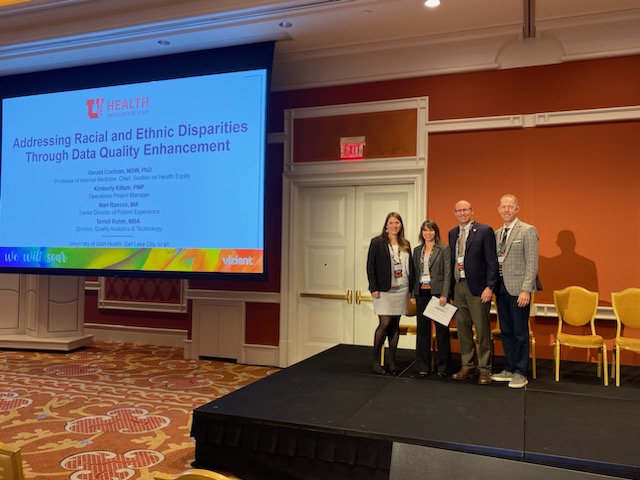
      "Addressing Racial and Ethnic Disparities through Enhancement of Data Quality"

      An oral presentation with Cochran G, Vanneman M, Gulbransen S, Ransco M, Curtis R, Killam K, and Rohm, T.  at the Vizient Connections Summit in Las Vegas, NV which was held from September 18-21, 2023. 

      Cochran G, Vanneman M, Gulbransen S, Ransco M, Curtis R, Killam K, and Rohm, T presenting at the Vizient conference.