About the Fellowship

The Pre-Residency Research Fellowship at the Alan S. Crandall Center for Glaucoma Innovation offers an immersive one-year experience designed for recent medical graduates preparing to enter ophthalmology residency. Fellows work closely with clinicians and clinician-scientists at the forefront of glaucoma innovation, gaining hands-on training in translational research and clinical investigation. Through direct mentorship, structured research projects, and exposure to patient care, fellows develop the scientific and analytical skills needed to contribute meaningfully to vision science and clinical advancement.

This program emphasizes curiosity, collaboration, and innovation in addressing the complex challenges of glaucoma and ocular disease. Fellows are integrated into the vibrant research ecosystem of the Moran Eye Center, contributing to studies that span novel surgical implants, clinical trial design, and population analytics. Graduates emerge with a competitive research portfolio, strong academic foundations, and a deep appreciation for the intersection of discovery and patient impact that defines modern ophthalmology.

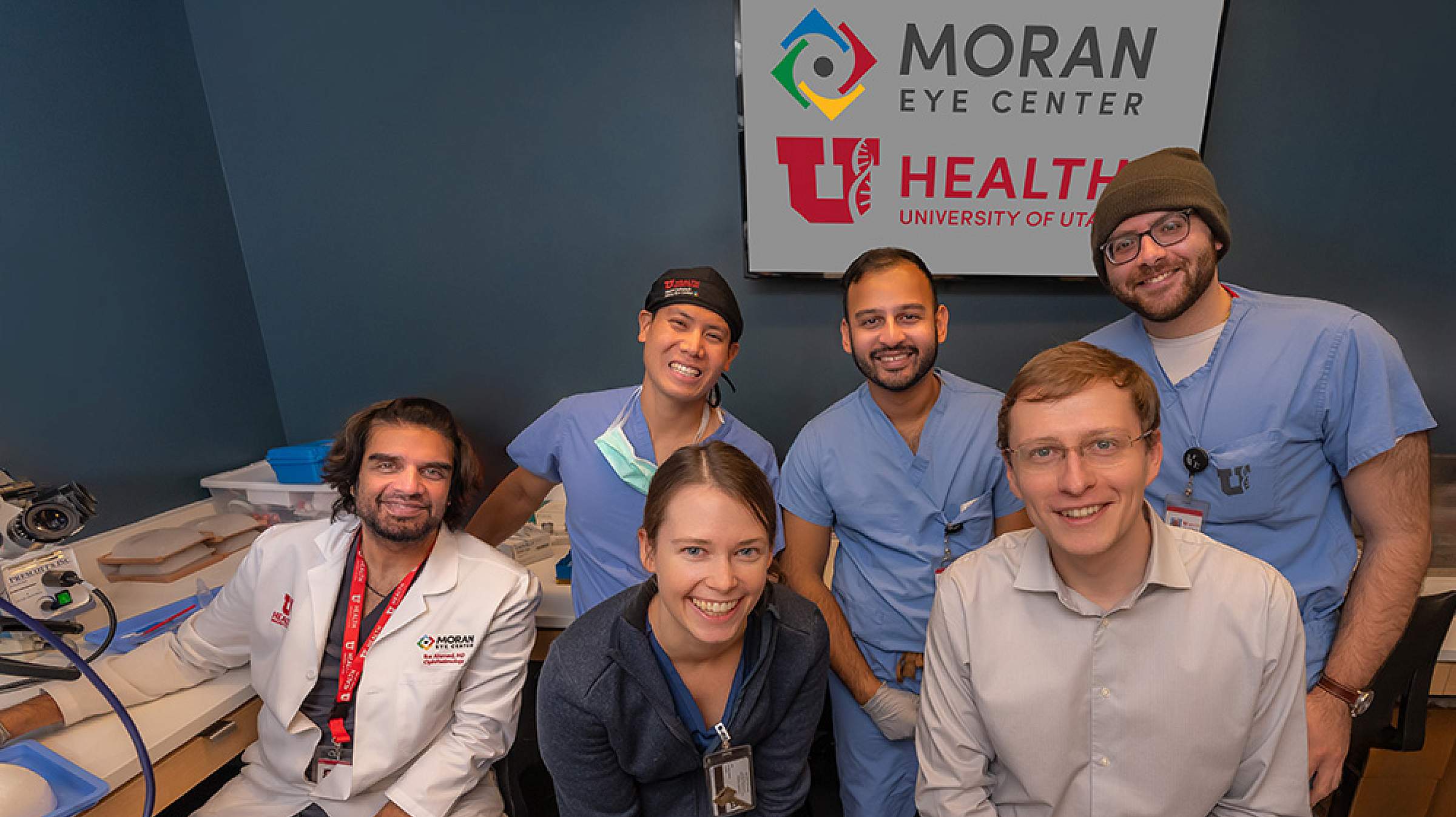
Crandall Center Glaucoma Fellow Research Team 2023
Research Fellows Team 2023-2024: From left, back row: Ike Ahmed, MD; Austin S. Nakatsuka, MD; Neil Kelkar, MD, ocular pathology fellow; and Kevin Eid, MD, ocular pathology fellow. Front row: Catherine Johnson, MD, glaucoma research fellow; and R. Evan Conrad, lab manager for Alan S. Crandall Center for Glaucoma Innovation.

Curriculum and Training

Mentorship

Each fellow is paired with a dedicated primary faculty mentor—Brian Stagg, MD, or Austin Nakatsuka, MD—for individualized guidance throughout the year. Fellows also receive direct supervision from Ian F. Pitha, MD, PhD, while conducting research in the Crandall Center’s laboratory. This ensures fellows receive both scientific direction and professional development support as they prepare for careers in ophthalmology.

We recognize one of the fellow’s core goals is to match into a competitive ophthalmology residency program. Our mentors are deeply engaged in this process, offering personalized guidance on applications, career development, and interview preparation.

In addition to their primary mentors, fellows collaborate with secondary mentors drawn from the broader glaucoma faculty at the Moran Eye Center. This provides access to diverse research interests, surgical expertise, and academic perspectives and allows fellows to tailor their experience to specific areas of interest such as biomechanics, neuroprotection, surgical techniques, and patient-centered outcomes.

Moran glaucoma faculty members
Moran glaucoma faculty members from left to right: Rachel Simpson, MD; Susan Chortkoff, MD; Ian Pitha, MD, PhD; Barbara Wirostko, MD; Craig Chaya, MD; Iqbal Ike K. Ahmed, MD, FRCSC; Roya Garakani, DO; Norm Zabriskie, MD; Austin Nakatsuka, MD; and Brian Stagg, MD.

Preclinical Glaucoma Implant Design

The Crandall Center collaborates with industry partners and early-stage start-ups to conduct preclinical evaluation of novel glaucoma implants and therapies. These partnerships leverage the center’s expertise in glaucoma surgery, biomaterials, and translational research to accelerate the development of innovative devices and therapeutics toward clinical application.

Our team performs a full spectrum of preclinical and translational studies, including GLP (Good Laboratory Practice)-compliant testing, ex vivo perfusion and flow models, and in vivo animal studies to evaluate safety, function, tissue response, and long-term biocompatibility. The center’s infrastructure supports regulatory-grade data collection and reporting, enabling collaboration at every stage of device and therapy development—from early prototype assessment to FDA submission preparation.

Fellows are directly involved in all phases of this process, contributing to study design, surgical procedures, data acquisition, histologic and imaging analysis, and sponsor communication. This hands-on experience provides a unique opportunity to understand the scientific, technical, and regulatory foundations of device innovation and prepares fellows for careers at the intersection of ophthalmic research, clinical practice, and industry development.

Enrichment Opportunities

Iqbal Ike K. Ahmed, MD, FRCSC, interacts with attendees at the 2025 Glaucoma Masterclass.
Ike Ahmed, MD, FRCSC, interacts with participants at a 2025 Glaucoma Masterclass.

Fellows can participate in a wide range of enrichment experiences throughout the year, including weekly grand rounds, resident teaching sessions, surgery observation, and submitting and presenting abstracts at national meetings.

The Moran Eye Center offers unique opportunities for local and global outreach care experiences with its Global Outreach Division, which trains physicians in low-resource countries and provides care to underserved populations in Utah and on the Navajo Nation.

Salt Lake City also hosts two notable events: The Glaucoma Masterclass and the Interventional Glaucoma Consortium. The Masterclass introduces providers to minimally invasive and emerging glaucoma therapies and treatments through didactic classes and hand-on wet labs. The Consortium is a high-level “think tank” meeting that convenes leading glaucoma surgeons, researchers, and industry partners to explore innovations in interventional glaucoma care—spanning minimally invasive glaucoma surgery (MIGS), sustained-release therapies, laser treatments and next-generation drainage devices.

Application Process

Applicants should either have an MD or DO degree. In addition to your resume, which you may have already forwarded, please send the following: a personal statement, three letters of reference, US-MLE steps 1, 2, or 3 scores, and any ECFMG certificates, if applicable. If it is more convenient, you may simply forward your central application match packet.

This glaucoma fellowship is a wonderful opportunity to gain valuable knowledge in ophthalmology along with ample opportunities for publications and presentations at national/international meetings. The basic stipend is approximately $44,000 per year.

Applications for the current year are closed. The application period is expected to reopen in early 2027.

Fellowship Contact

Tiffany Hobbs–Executive Assistant to Norm Zabriskie, MD, Austin S. Nakatsuka, MD, and Brian Stagg, MD.
Email: tiffany.hobbs@hsc.utah.edu
Phone: 801-585-3071
Fax: 801-581-3357

Current Fellows

Lieu Nguyen Lowrie, MD

Lieu Nguyen Lowrie, MD

2025-2026

Lieu Nguyen Lowrie, MD, is a graduate of the University of Kansas School of Medicine.

Charissa Tan, MD

Charissa Tan, MD

2025-2026

Charissa Tan, MD, is a graduate of the University of Hawaii John A. Burns School of Medicine.

Alumni

Michael Jensen, MD

Michael Jensen, MD

2024-2025

Meghan Sharma, MD

Meghan Sharma, MD, MPH

2024-2025

Catherine Johnson, MD, MPH

Catherine Johnson, MD, MPH

2023-2024

John A. Musser, MD, MPH

John A. Musser, MD, MPH

2022-2023

Updates From the Alan S. Crandall Center for Glaucoma Innovation

Where Glaucoma Innovation Meets Clinical Judgment

Crandall Center clinician-scientists Ike Ahmed, MD, FRCSC, and Ian F. Pitha, MD, PhD, share their perspectives on modern glaucoma care, emerging technologies, and more.

Read More

Why No. 22 Matters in Glaucoma Care — and Is It Time to Rethink It?

New research from the Moran Eye Center shows that while our understanding of glaucoma has advanced, ophthalmologists are still relying on a long-standing threshold number for eye pressure.

Read More

Advanced Glaucoma Care Comes Home

A handheld device that allows glaucoma patients to track their eye pressure at home is transforming care and research.

Read More

Lessons Learned: AMD to Glaucoma

With a new gene therapy for age-related macular degeneration in clinical trials, Gregory S. Hageman, PhD, is ready to take on glaucoma.

Read More

Education Program Resources

Contact Us

University of Utah School of Medicine

Department of Ophthalmology & Visual Sciences

John A. Moran Eye Center
Academic Office
65 Mario Capecchi Drive
Salt Lake City, UT 84132

Phone: 801-585-3719
Fax: 801-581-5806

Rachel G. Simpson, MD, Vice Chair of Education
Phone: 801-581-2352
rachel.simpson@hsc.utah.edu

Griffin J. Jardine, MD, Associate Program Director
Phone: 801-581-2352
griffin.jardine@hsc.utah.edu

Sravanthi Vegunta, MD, Associate Residency Program Director
Phone: 801-581-2352
srav.vegunta@hsc.utah.edu

Roya Garakani, DO, Associate Residency Program Director
Phone: 801-585-3071
roya.garakani@hsc.utah.edu

Meghan Johnson, Programs Manager, Academics
Phone: 801-213-4044
meghan.johnson@hsc.utah.edu

Chandler C. Thompson, Administrative Manager, Academics
Phone: 801-581-3023
chandler.thompson@hsc.utah.edu

Alexandra Ruiz, Academic Services
Phone: 801-215-6701
alexandra.m.ruiz@hsc.utah.edu